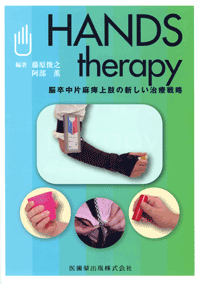
推薦のことば Several years ago when I paid a short visit to Japan,Dr Toshiykui Fujiwara demonstrated an early version of his HANDS device to me when I visited the rehabilitation department of his hospital.When I tried it on myself it was obvious that this was not quite the same type of device as I had been expecting. At the time I was very familiar with methods of functional electrical stimulation in which external electrical nerve stimulators are used to activate paralysed or paretic muscles.In general,the onset and offset of stimulation are usually controlled either by external switches or by detection of residual EMG activity at the onset of an intended voluntary movement.Typical examples are the heel strike switches that can trigger stimulation of the anterior tibial muscles to dorsiflex the ankle during hemiplegic gait,or EMG monitors on the forearm to detect onset of weak extensor EMG in stroke patients attempting to extend the wrist. Thus I was expecting a constant amount of stimulation to start when I produced a flicker of muscle activity in my extensors and for it to extend my fingers for a given amount of time.However this stimulator did not do that.At the beginning,the stimulus was weak,and it was only natural for me voluntarily to increase the level of EMG activity to try to start off the movement.As I did this,the intensity of stimulation increased in proportion and movement began quite naturally.The stimulator was assisting my effort rather than replacing it.This was a clever stimulator that was capable of monitoring the level of my voluntary EMG at the same time as delivering additional EMG via electrical stimulation.It was a servo rather than a switch. Since that time Dr Fujiwara has used the device with splints to retrain finger extension in over one hundred stroke survivors and has shown its benefits over standard therapy in a well-controlled clinical trial.The attraction for patients,is,I think,that it feels more natural that a switched stimulator because the wearer has complete moment to moment control of the amount of assistance required.It is this that may increase its effectiveness as a training tool.Certainly it is an attractive device to use in therapy and holds great potential in rehabilitation of finger control after stroke. With best wishes JOHN ROTHWELL Professor of Human Neurophysiology UCL Institute of Neurology,London