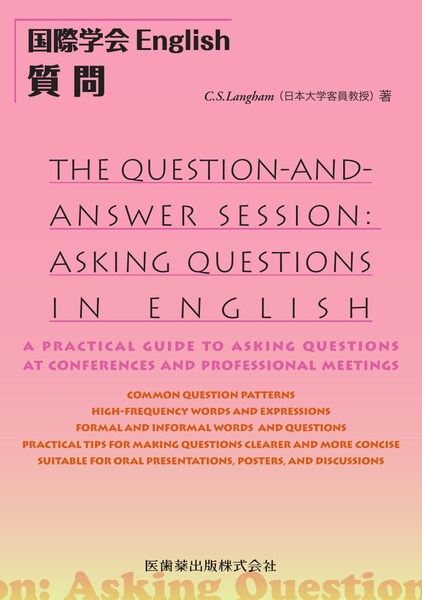
Preface Presentations are one of the main methods of reporting research results and are an important skill for people in a variety of fields.With the aid of presentation software programs, presenting is now less of a challenge.There are, however, two remaining issues.These are asking and answering questions. This book is for people who want to improve their ability to ask questions in the Q and A session.It has numerous example sentences as well as useful vocabulary that will improve the quality of your questions.Please note that this book does not cover how to answer questions.
Introduction This book focuses on asking questions.Model question patterns are introduced that are easy to use and will improve your question technique and confidence.Part 1 of the book focuses on situations such as checking information, asking for clarification, and critical comments.Part 2 introduces frequently used words and shows how they combine with other words and phrases in questions.There are numerous model question patterns.This book includes examples of general academic English and does not introduce vocabulary from a particular field.It is suitable for people who want to ask questions in oral presentations or poster sessions.It will also be of use to those who need English in the workplace.
Acknowledgments This book came about through teaching presentation skills to groups of scientists, researchers, and undergraduates in Japan over a period of more than 40 years.I wish to acknowledge participants on presentation skills programs that I have taught at the National Institute of Advanced Industrial Science and Technology and other institutes and universities in Japan.I would also like to mention some of the academic societies in Japan that provide training opportunities for junior doctors to improve their English presentation skills.Among others, these include the International College of Surgeons, Japan Section, the Japanese Society of Hepato-Biliary-Pancreatic Surgery, and the Japan Society of Immunology Allergology and Infection in Otorhinolaryngology.In recent years, I have attended presentation training sessions and acted as a commentator.This has been a valuable experience and many of the ideas and examples in this book have been derived from it. Clive Langham Nihon University Ochanomizu, Tokyo July 1st, 2026
目次
Part 1 Question focus 1 How to get the attention of the chairperson or presenter 座長/発表者に質問の意思を示す 2 Asking a question 質問の基本―2段階の質問法 3 Referring to a slide number スライド番号を指定して質問する 4 Checking information 発表内容について確認する 5 Asking for information 情報を求める 6 Asking for more/further information さらなる情報を求める 7 Asking for information that is not or only partially covered 発表で触れられなかった点について質問する 8 Asking a related question 関連した質問をする 9 Asking a follow-up or additional question 続けて別の質問をしたい時 10 Asking about a technique or method 手法/技術について質問する 11 When a presenter does not answer your question or misunderstands it 発表者が質問内容を誤解している時 12 Stating you did not understand something 発表内容で理解できない箇所があった時 13 Referring to a point made by the presenter 発表内容を引用して質問する 14 Asking for clarification 定義を確認する 15 Asking for a reason 理由を尋ねる 16 Commenting on a presentation コメントを述べる 17 Asking open-ended questions 「開かれた質問」をする 18 Asking about possibility 可能かどうかを尋ねる 19 Asking about solutions to a problem 問題の解決策を尋ねる 20 Asking about other possible approaches and methods 他の方法の有無を尋ねる 21 Checking that you understood something correctly 自分の理解が正しいかどうか確認する 22 Questions about related studies 関連研究/先行研究について質問する 23 Confirming/checking information 正しいかどうかを確認する 24 Asking for more details (実験手法などについての)詳細を尋ねる 25 Asking for a comparison between the data presented and data in the literature 文献との比較を尋ねる 26 Asking about possible applications どのように応用できるかを尋ねる 27 When you find it difficult to accept/agree with the information/data presented 提示された情報/データに納得できない時 28 Asking how important/significant something is 重要性について尋ねる 29 Introducing questions 自分の考えを述べた上で質問する 30 Asking someone to justify their results 根拠の説明を求める 31 Critical comments 1 批判的なコメント(1) 32 Critical comments 2 批判的なコメント(2) 33 Asking about remaining issues 残りの問題について尋ねる 34 Asking about future plans 今後の研究計画を尋ねる 35 Questions about time 時間についての質問 36 How to simplify a question by reducing its length 質問文を短くする方法 Part 2 Word focus Could Information Think about, consider Take into account, take into consideration Achieve, obtain, get Problems with, issues with, difficulty with, difficulties with Issue Wonder Perform, carry out, do Address, deal with, handle, tackle Eliminate, cut out, stop, reduce Solve, avoid, get over, get round/around, solution Equipped with, have Employ, use, apply, applicable Safe, safety Shorten, lengthen, widen, deepen Successful, success Notice, note, see, have Mentioned, told us, said Require, need, necessary Affect, have an effect on Impact, have an impact on Influence, have an influence on Effect Difference, different, differ Evaluate, assess, measure Observe, observation, see Imagine, visualize, envisage Compare with, fit in with, match Sufficient, adequate, enough If Happen Accurate, accuracy By using, using, with Guess, suppose, imagine, am I right in thinking See Because of, due to, as a result of Working on, involved in, are on/in Conventional, standard, normal, widely used Determine, decide Collaborate with/collaboration with, work with, do cooperative/joint research with, be involved in Typical, typically Related to/with, connected to/with, associated with, have anything to do with Please, could In the case of Discrepancy Justify Tell the difference between, distinguish between, differentiate between, discriminate between In terms of, as for, concerning