やさしさと健康の新世紀を開く 医歯薬出版株式会社

3,300円(税込)
品切れ
本書には最新版がございます.
詳細はこちら.

国際学会English スピーキング・エクササイズ
口演・発表・応答 音声CD付

発行時参考価格 3,000円
  • 総頁数:120頁 / 2色
  • 判型:A5判
  • 発行年月:2010年3月
  • ISBN978-4-263-43339-3
  • 注文コード:433390

聴いて・話して・English!

内容紹介

●リスニング,スピーキングは実践的な英語力を身につけるために不可欠なエクササイズ.実際の口演やディスカッションを収録したCDを聴き,話すことで,どんなシチュエーションでも物怖じしない“本物の英語力”が身につきます!
●大事なポイントは日本語で解説.使われている英語も平易なので,初心者でも安心して読むことができます.

◆本書のサンプル音声&練習問題をダウンロードできます.
・サンプル音声(MP3形式:約324KB)
・練習問題(PDF形式:約201KB)

本書のパンフレットはこちら(PDFファイル 約467KB)


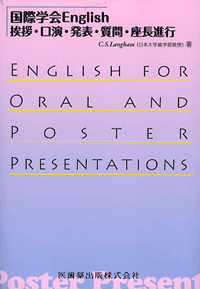
◆本書の姉妹本『国際学会English 挨拶・口演・発表・質問・座長進行』も好評発売中です!
序文

Introduction
Oral presentations have become one of the main ways of transmitting research results and an essential tool for professionals in a variety of fields.They are also important for graduate students and,to a lesser extent,undergraduates.
This book aims at meeting the needs of presenters who are non-native speakers of English.It is based on the author's experience of teaching presentation skills at universities and institutes in Japan over a period of twenty five years.During that time,I have noted a significant improvement in presentations given by Japanese presenters,but problems remain and,in my opinion,these are not simply matters of grammar or pronunciation.In fact,they are far more serious.For example,many presentations lack a clear framework,conform more to the rules of a written paper than an oral presentation,and do not distinguish between foreground and background.
In this book,I focus on ways of overcoming these and other problems.My approach is a linguistic one and I concentrate on the English you need to present your data.There are many example sentences and vocabulary items that you can use to improve your presentation and make your data more convincing.This book comes with a CD and has exercises that will help you to improve your speaking and listening ability,and also remember the key sentences and vocabulary presented here.It has four complete example introductions and three complete example conclusions.There are several quick guides that provide easy access to the language you need.Additionally,there is one interview with an experienced presenter and ten thought-provoking topics on presentations that introduce useful techniques.
You can use this book as a reference when you are preparing your next presentation and also as a textbook for improving your speaking and listening skills.

Acknowledgments
I wish to thank the following people who kindly allowed me access to their presentations,data and graphics.Professor A.R.Cools,Department of Psychoneuropharmacology,Nijmegen University,the Netherlands.Professor J.L.Waddington,Department of Molecular and Cellular Therapeutics,Royal College of Surgeons in Ireland.Dr.Mathew Brett,the MRC-Cognition and Brain Sciences Unit,Cambridge University,Cambridge,England.Dr.Patrick Micke,the Cancer Center,Karolinska,Stockholm,Sweden.Dr.Amar Gandavadi,Birmingham University,School of Health Sciences,Physiotherapy,University of Birmingham,Edgbaston,Birmingham,England.Dr.Toshiyuki Kanamori,Institute of Advanced Industrial Science and Technology,Japan.I also wish to acknowledge my friend and colleague,Brian Purdue of Tsukuba University,with whom over the years I have had many valuable discussions concerning presentation techniques.Thanks are also due to Dan Waldhoff for his help with recording.Finally,I should also like to thank Michael Jones for his useful comments on the manuscript.
 Clive Langham
 Nihon University
 School of Dentistry
 Ochanomizu,Tokyo
 February 1st,2010

目次

 Introduction
 Acknowledgments
Part1 Starting your presentation
 1 You need a framework
 2 Example Introduction 1
 3 Example Introduction 2
 4 Example Introduction 3(Part1)
 5 Example Introduction 3(Part2)
 6 Example Introduction 4
  Quick Guide 1: Starting your presentation-Key Sentences
  Quick Guide 2: Starting your presentation-Key Vocabulary
Presentation Techniques: Discussion
Part2 How to handle the main body of your presentation
 1 Starting a new section
 2 Focusing on important points in a section
 3 Finishing sections with a short summary
 4 Signaling the end of a section
 5 Movement within a presentation
 6 Using questions in the main body
 7 Contrasting known information and new information
 8 How to introduce graphics in a dynamic way
Part3 How to handle conclusions
 1 Advice for effective conclusions
 2 Example conclusion 1
 3 Example conclusion 2
 4 Example conclusion 3
  Quick Guide 3: How to handle conclusions-Key Sentences
Part4 The question and answer session
 1 How to handle questions
 2 Defining question types
Presentation Topics
 1 What makes a good presentation?
 2 If you could get people to do one thing differently in their presentations,what would it be?
 3 No two specialists are alike
 4 What is obvious to you,may not be obvious to your audience
 5 How sticky is your presentation?
 6 Poster previews
 7 Buzz sessions
 8 Networking receptions
 9 Clarity: How to simplify and rephrase complex information
 10 Less is more

著者所属/略歴 ※本書が刊行された当時のものです.現在とは異なる場合があります.

【著者略歴】
C.S.Langham
 1976年 ハダースフィールド大学卒業
 1982年 ケント大学大学院修了
 2000年 日本大学歯学部教授(英語)

執筆者の関連書籍を探す場合は下に表示された名前をクリックしてください

C.S.Langham 著